

Real estate investing is one of the most popular ways to build wealth over time. It means buying, owning, managing, renting, or selling property to make money. People do it to earn monthly rental income, to grow their wealth slowly, or to make profit when they sell a property later. This guide explains real estate investing in very simple English so that anyone can understand the basics, strategies, risks, and how to start safely.investopedia+2
If you are new to real estate investing, this post will help you learn everything you need to know before putting money into any deal. It covers different investment types, how investors make money, the benefits, the risks, financing, and how to avoid common mistakes. It also includes a clear step-by-step plan for beginners who want to get started the right way.investopedia+3
What Is Real Estate Investing?
Real estate investing means using money to buy property with the goal of making more money later. The property can be a house, apartment, shop, office, land, warehouse, or even a share in a_REIT or property fund. Some investors hold property for many years. Others buy, fix, and sell quickly. Some invest without owning physical property at all.investopedia+1
The main goal of real estate investing is to earn more than you spend. This can happen through rent, property value growth, or resale profit. Many people like real estate because it can feel more real and easier to understand than some other investments like stocks or bonds.investopedia+2
Real estate investing can fit into a larger investment plan. It can help you diversify your portfolio, which means spreading your money across different types of assets to reduce risk. It may also act as a hedge against inflation because property values and rents can rise over time.investopedia
Why Do People Invest in Real Estate?
People invest in real estate for many reasons. Some want monthly income. Others want long-term growth. Some want both at the same time. Real estate can also help balance a portfolio that already has stocks, bonds, or other assets.investopedia+1
Here are some common reasons people choose real estate investing:
- Monthly rental income that can pay for living costs or build savings.
- Long-term appreciation, which means the property becomes more valuable over time.
- Control over the asset, because you can improve the property and affect its value.
- Tax benefits in some markets, such as deductions for interest, repairs, and depreciation.
- Portfolio diversification, which can reduce overall risk.
- Protection against inflation, as property values and rents may rise when prices go up.investopedia+1
Many investors also like real estate because it is tangible. You can see it, touch it, and visit it. This makes it easier for some people to understand compared to shares in a company that they never see.investopedia
Main Types of Real Estate Investing
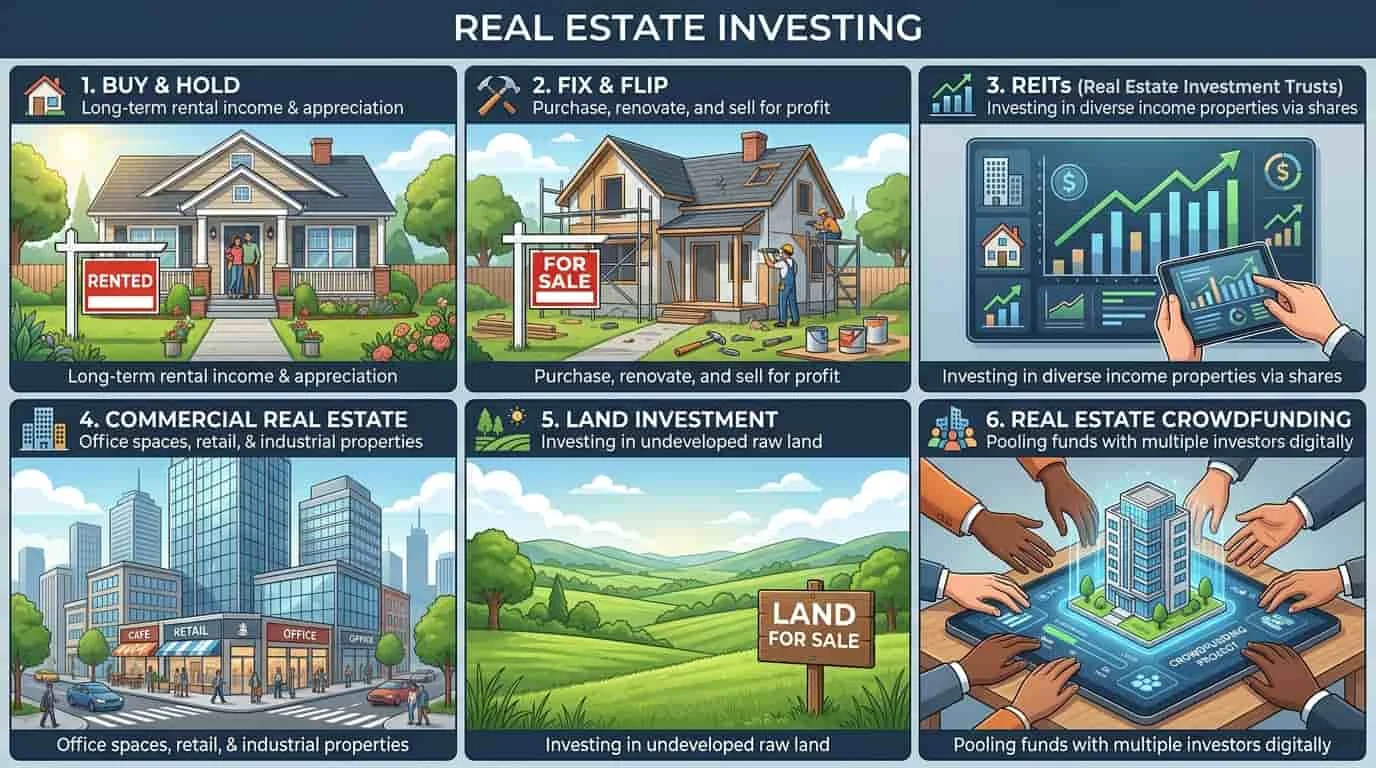
There are several ways to invest in real estate. Each one works differently and has its own risks and rewards. The best choice depends on your money, your time, your risk level, and your goals.investopedia+2
1. Buy and Hold (Rental Property)
Buy and hold means buying a property and keeping it for a long time. Most investors who use this strategy rent the property to tenants and collect monthly rent. Over time, the property may also increase in value, which can lead to profit when it is sold.investopedia+1
This is one of the most common real estate investing strategies for beginners. It can be a good choice if you want steady income and are ready for long-term ownership. But it also needs patience, property management, and money for repairs, taxes, insurance, and other costs. If the tenant leaves or the house needs big repairs, your profit can go down.investopedia+1
2. Fix and Flip
Fix and flip means buying a property below market price, improving it, and selling it for a higher price. This can bring faster profit than renting, but it also carries more risk. You need a good understanding of repair costs, time needed, and resale value.investopedia+2
Many beginners like the idea of flipping because it sounds exciting. But it is not easy money. Renovation costs can be higher than expected. The market can change before the home is sold. If the property does not sell quickly, your profit can shrink or disappear.realestateskills+1
3. REITs (Real Estate Investment Trusts)
_REITs, or real estate investment trusts, let you invest in real estate without buying a physical property. You buy shares in a company that owns, manages, or finances real estate. This gives you indirect exposure to property markets.investopedia+1
REITs are often easier for beginners because they need less money and less management. You do not have to deal with tenants, repairs, or insurance the same way you do with a house. But REITs can still rise and fall in value, and they are affected by market conditions, interest rates, and investor sentiment.investopedia+1
4. Commercial Real Estate
Commercial real estate includes offices, shops, malls, warehouses, and other business spaces. Some investors prefer this type because it can bring strong rental income and longer leases than residential property. Longer leases can mean more stable income over time.realpha
At the same time, commercial property can be harder to buy and manage. It may need more money, more research, and more market knowledge. If business demand falls, the property may sit empty for a long time, which can hurt cash flow.theinvestorsedge+1
5. Land Investing
Land investing means buying raw land and waiting for its value to rise. Some people buy land for future development. Others hold it for appreciation. It can be simpler than managing a house because there are no tenants or repairs.realpha
Still, land can be harder to sell than a home. It may not produce income unless you lease it or develop it. So it is often more of a long-term play than a quick profit method.realpha
6. Real Estate Crowdfunding and Platforms
Some investors use real estate investing platforms or crowdfunding services. These platforms let many people put money into one property or project. They can lower the entry cost and make real estate more accessible.rankvault
This can be useful for beginners who do not want full ownership responsibilities. But you still need to check fees, liquidity, platform quality, and risk before investing. Not every platform is the same, and some may not be well regulated.rankvault
How Do Real Estate Investors Make Money?
Real estate investing usually makes money in several ways. Understanding these methods helps you choose the right strategy and avoid bad deals.investopedia+2
Rental Income
Rental income is money you get from tenants who pay to live in or use your property. If the rent is higher than your costs, you earn monthly profit. This is called positive cash flow.investopedia
Many investors focus on cash flow because it can pay for living costs, build savings, or fund more investments. But rental income is not guaranteed. Tenants can leave, pay late, or cause damage. Vacancy and repair costs can reduce your profit.investopedia+1
Appreciation
Appreciation means the property becomes more valuable over time. This can happen because of population growth, better infrastructure, strong local economy, or high demand. When you sell an appreciated property, you may make a profit.theinvestorsedge+1
Appreciation is not guaranteed. Property values can fall in some markets or during tough economic times. That is why it is important to choose location carefully and not rely only on future price growth.investopedia+2
Profit from Resale
Profit from resale often comes from fix and flip deals. You buy a property below market value, improve it, and sell it for a higher price. If your costs stay under control and the market stays healthy, you can make a good return.investopedia+2
But resale profit depends on many factors: repair costs, selling price, time on market, and local demand. If any of these go wrong, your profit can shrink or turn into a loss.realestateskills+1
Leverage
Leverage means using borrowed money to buy property. If the property grows in value, the investor may make a good return on the money they actually put in. For example, if you put 20% down and the property value rises, your return on your cash can be higher than the overall property return.investopedia+1
But borrowing also adds risk, because loan payments must be made even when income is low. If rent stops or the property stays empty, you still owe the bank. That is why many experts warn beginners not to borrow too much too soon.realestateskills+1
Benefits of Real Estate Investing
Real estate investing can offer several benefits. These benefits make it attractive to many investors, especially those who want long-term wealth and some control over their assets.investopedia+1
Monthly Cash Flow
Monthly cash flow from rent can help pay for living costs, build savings, or fund more investments. If your property is well managed and located in a strong rental area, you may earn steady income for years.investopedia
Long-Term Growth
Over time, property values may rise due to population growth, development, and demand. This long-term growth can build wealth slowly but steadily.realpha
Tax Advantages
In some markets, real estate investors can get tax benefits such as deductions for mortgage interest, repairs, and depreciation. These can reduce your taxable income and increase your net return. But tax rules vary by country and region, so you should always check with a local tax expert.investopedia
Portfolio Diversification
Real estate can help balance a portfolio that already has stocks, bonds, or other assets. Because real estate may not move exactly the same as other assets, it can reduce overall risk.investopedia
Inflation Protection
Property values and rents can rise over time, which may help protect your money against inflation. This is one reason many long-term investors include real estate in their plans.investopedia
Control Over the Asset
Unlike some other investments, real estate gives you direct control over the asset. You can improve the property, change how it is managed, or adjust rent to increase income. This sense of control is one reason many people like real estate investing.investopedia+1
Risks and Challenges in Real Estate Investing
Real estate investing is not risk-free. Every strategy has risks, and every market has challenges. Understanding these risks helps you prepare and avoid big mistakes.realestateskills+1
Vacancy Risk
Vacancy risk means your property may stay empty for some time. When there is no tenant, you do not get rent, but you still have to pay loan, taxes, insurance, and maintenance. This can hurt your cash flow and stress your budget.investopedia+1
Repair and Maintenance Costs
Repairs and maintenance can be expensive and unpredictable. A small problem can become a big one if you do not catch it early. Old roofs, plumbing issues, and electrical problems can cost a lot to fix.investopedia+2
Market Risk
Market risk means property values and rents can fall due to economic problems, job losses, or too much supply. If you buy at a high price and the market drops, you may lose money when you sell.investopedia+1
Tenant Problems
Tenant problems are common in rental investing. A tenant may pay late, damage the home, or leave suddenly. Local laws can also affect how you collect rent or remove a bad tenant. That is why every investor should understand both the numbers and the legal side before buying.investopedia+2
Interest Rate Risk
Interest rate risk means your loan cost can rise if rates go up. If you have a variable-rate loan, your monthly payment may increase, which can hurt cash flow.theinvestorsedge
Leverage Risk
Leverage risk comes from borrowing too much. If the property value falls or income drops, you may still owe more than the property is worth. This can lead to big losses or even foreclosure if you cannot pay.theinvestorsedge
Key Numbers Every Investor Should Know
Good real estate investing depends on simple numbers. You do not need to be a finance expert, but you do need to understand basic math. Before buying, look at purchase price, rent, repairs, taxes, insurance, loan cost, and likely resale value.investopedia+1
Purchase Price
Purchase price is what you pay to buy the property. A lower price can mean better potential return, but only if the property is in good condition and in a strong location.theinvestorsedge
Rental Income
Rental income is the money you expect to receive from tenants each month. You should compare this with similar properties in the same area to see if your estimate is realistic.investopedia+1
Operating Expenses
Operating expenses include taxes, insurance, maintenance, management fees, and other ongoing costs. These can add up fast and reduce your profit if you do not plan for them.theinvestorsedge
Cash Flow
Cash flow is the money left after you pay all costs and loan payments. Positive cash flow means you earn more than you spend. Negative cash flow means you lose money each month.investopedia+1
Return on Investment (ROI)
Return on investment measures how much profit you make compared to the money you put in. A higher ROI usually means a better deal, but only if the risk is acceptable.theinvestorsedge
Cap Rate
Cap rate is a measure used mostly in commercial real estate. It shows the expected return on a property based on its income and price. It helps compare different properties quickly.realpha
How to Evaluate a Property Before Buying
Before buying, compare the property with similar properties in the same area. This helps you understand fair value, rent potential, and resale demand. Also check local demand, population growth, schools, roads, jobs, and nearby facilities. These factors can affect both rent and future price.theinvestorsedge
Study the Location
Location is one of the most important factors in real estate investing. A good location can support higher rent, faster appreciation, and lower vacancy. Look for areas with strong jobs, good schools, safe streets, and growing population.investopedia+2
Compare Similar Properties
Compare the property with similar ones nearby to see if the price and rent are fair. If most similar homes are selling for less, your deal may not be good. If most similar homes rent for more, your income estimate may be too low.theinvestorsedge
Inspect the Property
You should also inspect the property carefully. Look for roof problems, water damage, old wiring, plumbing issues, and structural concerns. Small visible problems can hide bigger costs. A good deal can turn bad very quickly if the repair budget is wrong.realestateskills+1
Check Legal and Zoning Rules
Check local laws, zoning rules, and rental regulations before buying. Some areas have strict rent control, eviction rules, or short-term rental limits. These can affect your income and exit plan.investopedia+1
Financing Options for Real Estate Investing
Most people use some kind of financing in real estate investing. A mortgage is the most common form of borrowing. Other options may include private money, cash, partnerships, or platform-based investing. The right option depends on your situation.investopedia+2
Traditional Mortgages
Traditional mortgages are loans from banks or other lenders. They usually need a good credit score, stable income, and a down payment. Interest rates and terms can vary based on your credit and the property type.investopedia+1
Private Money and Hard Money Loans
Private money and hard money loans come from individuals or small companies. These are often used for fix and flip deals because they can be faster but more expensive. They usually have higher interest rates and shorter terms.theinvestorsedge
Cash Purchases
Cash purchases mean buying without borrowing. This can reduce risk and cost because there is no loan payment or interest. But it also ties up more of your money in one asset.theinvestorsedge
Partnerships
Partnerships mean working with other people to buy property. One partner may provide money, another may manage the property. This can help you do bigger deals with less personal cash.theinvestorsedge
Real Estate Platforms
Real estate platforms let you invest in property projects with other people. This can lower the entry cost and make real estate more accessible. But you still need to check fees, liquidity, platform quality, and risk before investing.rankvault
Best Real Estate Investing Strategy for Beginners
For beginners, the easiest strategy is usually the one that matches your money, time, and comfort level. Many guides suggest starting with one simple path instead of trying to do everything at once. That can mean a small rental, a_REIT, or a low-risk deal with clear numbers.investopedia+3
A beginner should avoid rushing. Learn the market first. Study prices, rents, and expenses. Understand how returns work. Then move step by step. The safest start is usually the one where you can clearly explain how you will make money before you buy.realestateskills+1
Many experts suggest that beginners start with one property and learn from it before buying more. This helps you understand the real costs, the real work, and the real risks. Once you have experience, you can consider bigger or more complex deals.realestateskills+1
Step-by-Step Plan to Start Real Estate Investing
Here is a simple path for getting started in real estate investing:realestateskills+1
- Learn the basics of real estate investing.
- Choose one strategy.
- Check your budget and credit.
- Study your local market.
- Compare similar properties.
- Calculate income and costs.
- Inspect the property.
- Know your exit plan.
- Start small.
- Keep learning.realestateskills+1
Each step matters. The biggest beginner mistake is buying too fast without enough research. Another mistake is ignoring hidden costs. A calm and simple process usually works better than a rushed one.realestateskills+1
Step 1: Learn the Basics
Before you spend money, spend time learning. Read guides, watch videos, and talk to experienced investors. Understand the main strategies, risks, and numbers.realestateskills+1
Step 2: Choose One Strategy
Choose one strategy that fits your money, time, and risk level. Do not try to do everything at once. Focus on one path until you gain experience.realestateskills+1
Step 3: Check Your Budget and Credit
Check how much money you can invest and what kind of loan you can get. Your credit score, income, savings, and existing debt can affect your options.theinvestorsedge
Step 4: Study Your Local Market
Study your local market to understand prices, rents, and demand. Look for areas with strong jobs, good schools, and growth signs.theinvestorsedge
Step 5: Compare Similar Properties
Compare the property with similar ones nearby to see if the price and rent are fair. This helps you avoid overpaying.theinvestorsedge
Step 6: Calculate Income and Costs
Calculate expected income and all costs, including loan, taxes, insurance, repairs, and management. Make sure the numbers make sense before you buy.theinvestorsedge
Step 7: Inspect the Property
Inspect the property carefully to find hidden problems. Small issues can become big costs if you ignore them.realestateskills+1
Step 8: Know Your Exit Plan
Know how you will exit the deal if things go wrong. Will you hold long term? Will you sell after repair? Will you refinance? Having an exit plan reduces risk.theinvestorsedge
Step 9: Start Small
Start with one small deal to learn and gain confidence. Do not try to do too much too soon.realestateskills+1
Step 10: Keep Learning
Keep learning from every deal, every mistake, and every success. Real estate investing is a long-term skill that improves with experience.realestateskills+1
What to Look for in a Real Estate Market
The best market is usually one with strong demand, stable jobs, and good growth signs. Look for places where people want to live, work, or do business. Population growth, transport links, schools, and local development can all help property values.theinvestorsedge
You should also watch supply and demand. If too many homes are for sale and too few people are buying, prices may stay weak. If demand is strong and supply is limited, the market may be more favorable. This is one reason location matters so much in real estate.investopedia+2
Real Estate Investing vs. Other Investments
Real estate is different from stocks, bonds, and gold. With stocks, you usually do not control the business. With real estate, you can improve the asset directly. With bonds, the return is often fixed. With property, returns can come from rent, growth, and resale.investopedia+2
Real estate can also feel more stable than some other assets. But it is less liquid, which means you cannot always sell it quickly. That is why many investors treat it as a long-term investment instead of a fast trade.investopedia+1
Common Mistakes in Real Estate Investing
Many beginners make the same mistakes in real estate investing. They buy based on emotion instead of numbers. They underestimate repairs. They forget taxes and insurance. They choose the wrong area. They do not have an exit plan.realestateskills+1
Another common mistake is thinking every property will make money. That is not true. Some deals are bad even if the house looks nice. Good investors focus on value, demand, and risk, not just appearance.theinvestorsedge
Mistake 1: Buying Too Fast
Buying too fast without enough research is a big mistake. A good deal should make sense on paper before you buy.realestateskills+1
Mistake 2: Ignoring Hidden Costs
Ignoring hidden costs like repairs, taxes, and insurance can hurt your profit. Always include all costs in your calculation.theinvestorsedge
Mistake 3: Choosing the Wrong Area
Choosing the wrong area can lead to low rent, high vacancy, or slow growth. Location is one of the most important factors in real estate.investopedia+2
Mistake 4: Borrowing Too Much
Borrowing too much can increase risk and stress. If income drops or the market falls, you may struggle to pay your loan.theinvestorsedge
Mistake 5: No Exit Plan
Having no exit plan can lead to panic and bad decisions. Always know how you will exit a deal if things go wrong.theinvestorsedge
Simple Real Estate Investing Example
Imagine you buy a small flat and rent it out. The rent covers your loan, taxes, insurance, and maintenance, and you keep the extra money. Over time, the flat may also rise in value. If the area grows and demand stays strong, you may later sell at a higher price.investopedia+2
Now imagine a flip deal. You buy a home below market value, repair it, and sell it. If repairs stay on budget and the market stays healthy, you may earn a profit. If repairs go over budget or sales slow down, your profit may disappear.investopedia+2
Final View
Real estate investing is one of the most popular ways to build wealth because it can offer income, growth, and control. It also gives you several ways to invest, from rentals and flips to_REITs and platforms. But it only works well when you understand the numbers, the market, and the risks.investopedia+4
For beginners, the best approach is simple: learn first, start small, and choose one clear strategy. Real estate can be rewarding, but it is not magic. Smart research, patience, and good decisions matter more than hype.investopedia+2
Frequently Asked Questions (FAQ)
- What is real estate investing?
Real estate investing means buying, owning, managing, renting, or selling property to make money. The goal is to earn more than you spend through rent, property value growth, or resale profit.investopedia
- Is real estate investing good for beginners?
Yes, real estate investing can be good for beginners if they start small and learn first. Many experts suggest beginners choose one simple strategy and gain experience before doing bigger deals.realestateskills+1
- What is the best strategy for beginners?
The best strategy for beginners is usually the one that matches their money, time, and risk level. Many beginners start with a small rental property or a_REIT to learn the basics.investopedia+3
- How much money do I need to start?
The amount of money needed depends on your strategy and market. Some strategies need a lot of cash, while others like_REITs or platforms can start with less.investopedia+2
- Can I invest in real estate without buying property?
Yes, you can invest in real estate without buying physical property by using_REITs or real estate platforms. These let you invest in property projects with other people.investopedia+1
- What are the main risks?
The main risks include vacancy, repair costs, market drops, tenant problems, interest rate changes, and leverage risk. Understanding these risks helps you prepare and avoid big mistakes.investopedia+3
- How do I choose the right property?
Choose the right property by studying location, comparing similar properties, inspecting the home, and calculating income and costs. A good deal should make sense on paper before you buy.theinvestorsedge
- Do I need a loan to invest?
No, you do not need a loan to invest, but many investors use financing to buy property. Loans can help you buy bigger deals, but they also add risk.investopedia+1
- How long does it take to make money?
The time it takes to make money depends on your strategy. Rental investing may take months or years to build profit, while fix and flip deals can be faster but riskier.investopedia+1
- Can I lose money in real estate investing?
Yes, you can lose money in real estate investing if the market falls, costs rise, or income drops. That is why research, planning, and risk management are important.